2026
Antenna tests
An afternoon in the garden with a spectrum analyser, comparing antennas one at a time.
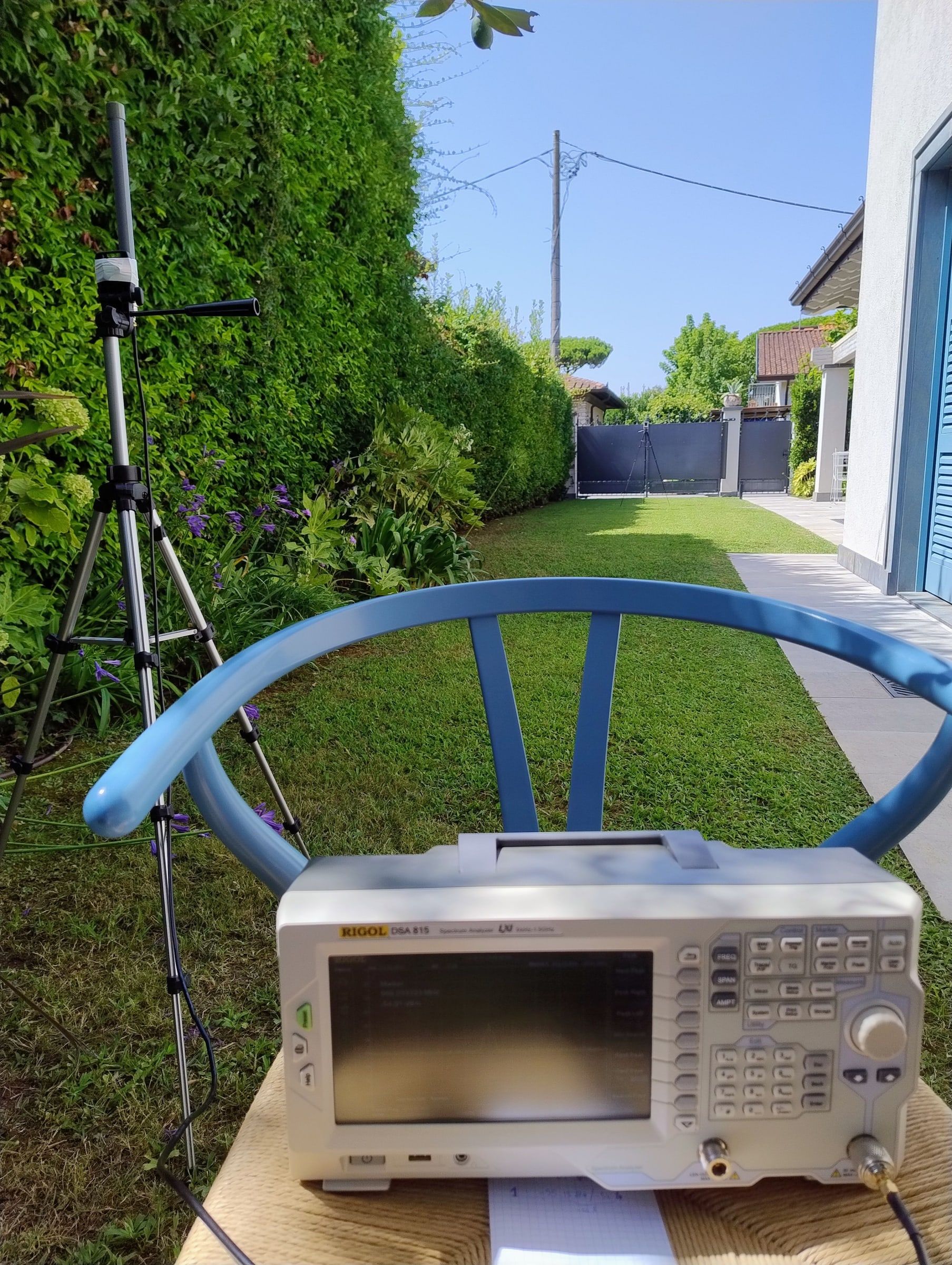
One antenna can look just like another: a white stick with a connector at the bottom. The box states a gain figure, but that number tells you little until you test it. On 5 August 2026 I spent an afternoon in the garden doing exactly that: taking a handful of antennas and measuring them, one at a time, under the same conditions. In those same days I did the same with filters and amplifiers.
How I measured
On one side a transmitter, a HackRF One with its PortaPack, on a tripod 1.65 metres off the ground: it sends a steady carrier at 869 MHz, the band used by LoRaA way of sending small amounts of data by radio, but very far and using very little battery. networks in Europe, at a power I measured myself, -6.84 dBmA measure of power: 0 dBm is one milliwatt and every 10 more means ten times as much. -60 dBm is a millionth of a milliwatt.. On the other, 10.40 metres away, the Rigol DSA815 spectrum analyserAn instrument that shows how much radio power there is at each frequency, like an equaliser for radio waves. with the antenna under test at a height of 1.25 metres. Nothing was allowed to change between one measurement and the next, except the antenna.
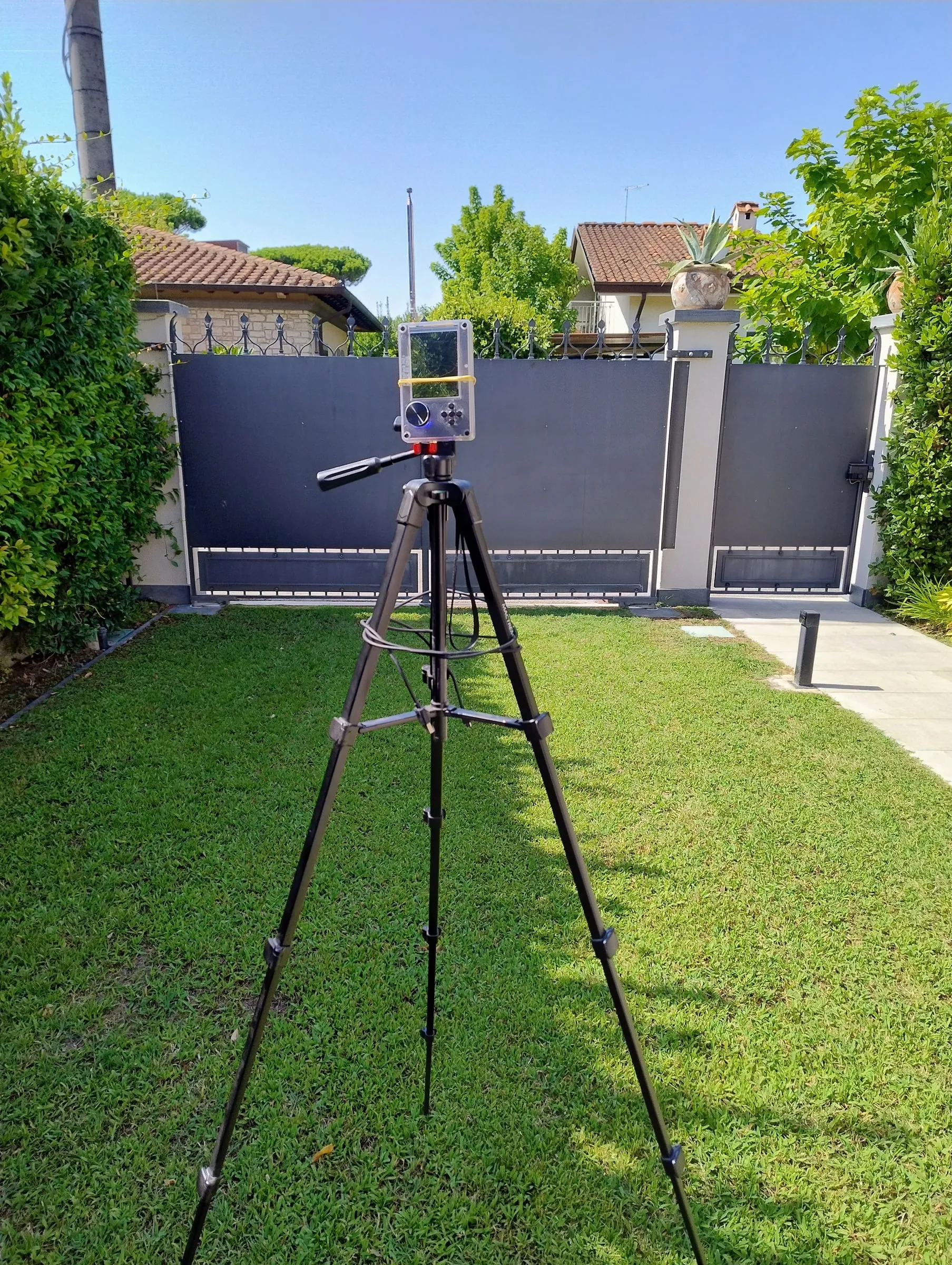 The transmitter on its tripod, ten and a half metres away.
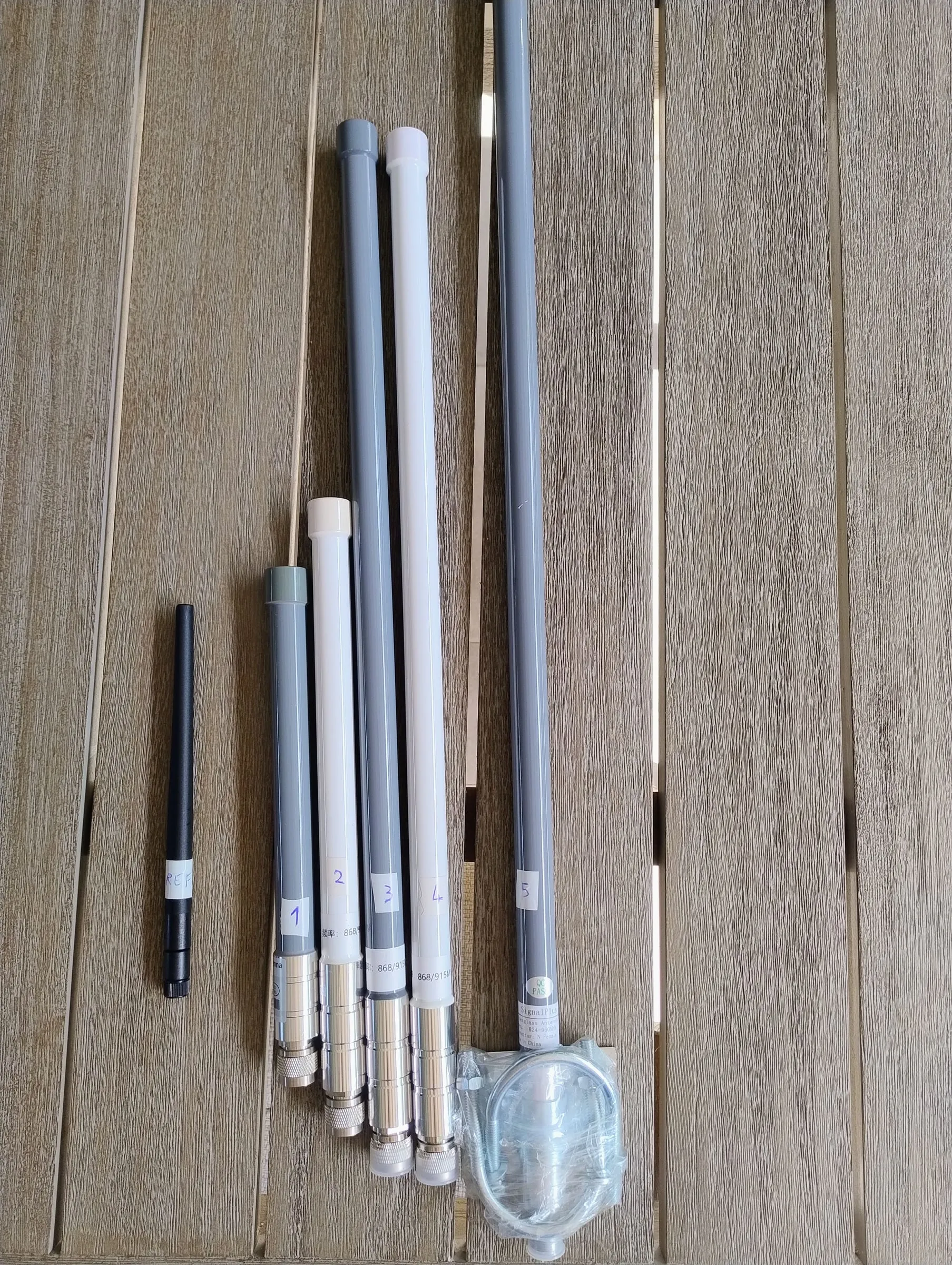 The antennas to compare.
First I measured a reference antenna, a rubber-duck like the ones on handheld radios, then the other five. Each value is the average of two or three readings.
| Antenna | Type | Received power | Gain over the reference |
|---|---|---|---|
| Reference | rubber duck | -60.97 dBm | 0.00 dB |
| 1 | sleeve dipole, short | -54.78 dBm | +6.19 dB |
| 2 | sleeve dipole, medium | -54.32 dBm | +6.65 dB |
| 3 | collinear, grey | -53.55 dBm | +7.42 dB |
| 4 | collinear, white | -52.52 dBm | +8.45 dB |
| 5 | collinear, long | -52.36 dBm | +8.61 dB |
The best one, the long collinearA vertical antenna made of several sections in a row: it focuses the signal towards the horizon instead of wasting it on sky and ground., received 8.61 dBThe decibel says how many times stronger one thing is than another: +3 dB is about double, +10 dB is ten times. more than the reference: more than seven times the signal, from the same distance and with the same transmitter. Antennas 4 and 5 are very close, and the likely reason is aiming: long collinears have a narrow radiation lobe, and just a few degrees of tilt, about two here, are enough to lose part of the advantage.
A sanity check on the sums: at 869 MHz and 10.40 metres the free-space path loss is 51.57 dB, so with that transmit power an ideal antenna should have received -58.41 dBm. The reference rubber duck is 2.56 dB below that, which is what you’d expect once you allow for cable losses, antenna efficiency and ground reflections.
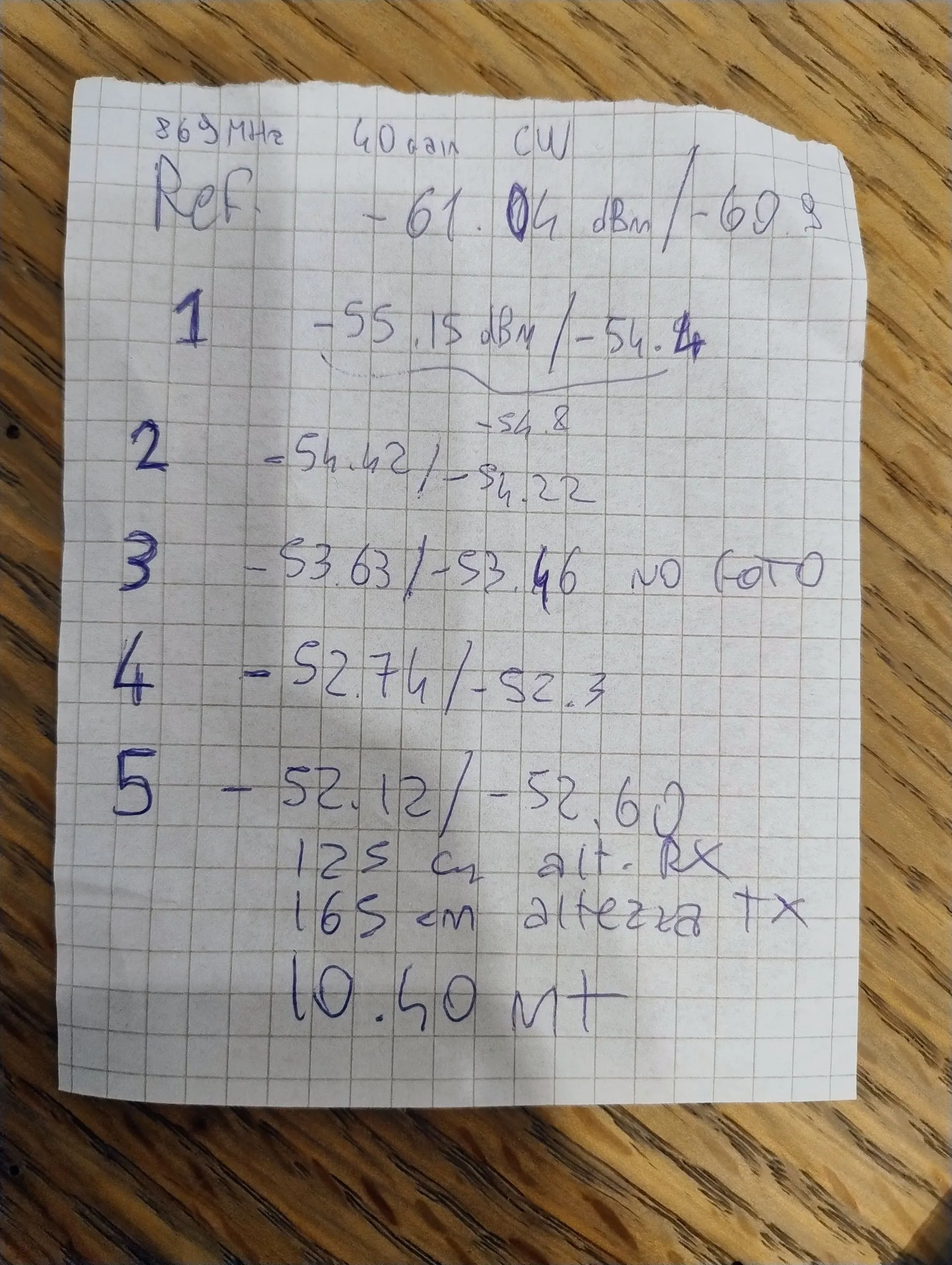 My notes from the afternoon.
I wrote the measurements by hand on a scrap of paper and then tidied them into a report, with photos of the setup and screenshots of the analyser: download the antenna report (PDF, in Italian).
Filters and amplifiers
I also measured three SAWA filter that uses tiny sound waves inside a crystal to let only a narrow band of frequencies through. filters, the kind that let only the band you need through, using the Rigol’s built-in tracking generator. For each one I looked at how much signal is lost in the middle of the band and how much is cut out of band.
| Filter | Loss at band centre | Out-of-band attenuation |
|---|---|---|
| 1, standard barrel | -3.67 dB | -43.64 dB |
| 2, sturdy and shielded | -3.69 dB | -42.73 dB |
| 3, light barrel | -3.89 dB | -41.43 dB |
All three cut well out of band, but the loss at the centre is higher than you’d expect from these filters, usually between 1.5 and 2.5 dB. It could come from an imperfect match between instrument and filter, from cables and connectors, or simply from unexceptional samples.
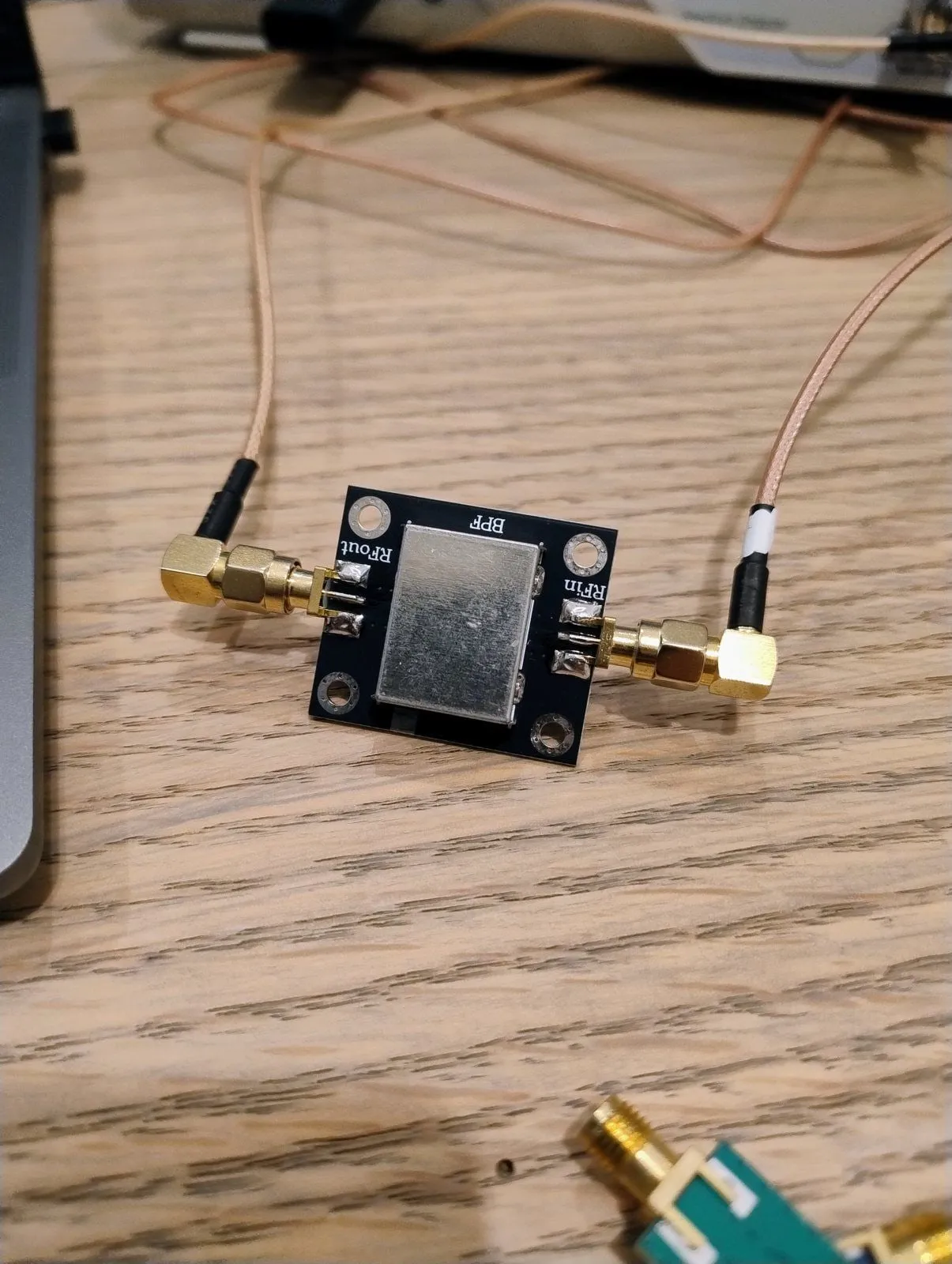 Filter 2, the sturdy shielded one.
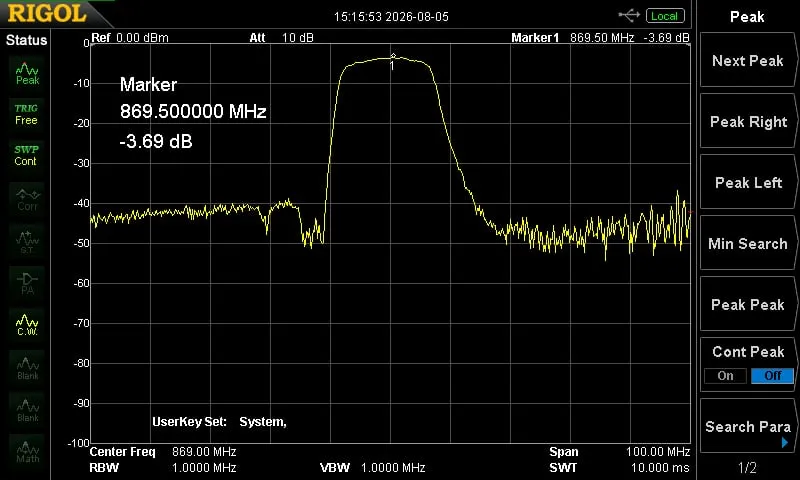 Filter 2’s response on the Rigol: -3.69 dB at the centre.
Then two modules. One has an amplifier for both transmit and receive and switches between the two on its own: with +8.32 dBm in it gives +21.14 out, that is +12.82 dB, and on receive it amplifies by +9.90 dB. The other chains a filter and a low-noise amplifier, for receive only: +20.45 dB of gain at the centre, and positive gain between 859.2 and 878.5 MHz. All the numbers and screenshots are in the report: download the filter report (PDF, in Italian).
What I learned
That the gain printed on the box should be taken with a pinch of salt, and the only way to know is to measure. That to compare two things you have to keep everything else still: the distance, the heights, the transmitter, even the chair. And that an instrument’s answer should always be checked with a calculation: if the numbers don’t match the theory, there’s something to understand.