since 2022
A wire to Grandma’s
A modem standing idle in my grandparents’ house, then modems on my desk, an analogue exchange and a phone network of my own, up to a wire that brings the internet to my grandmother’s house.
I was born when ADSL already existed. The sound of a modemThe device that turns a computer’s data into the sounds or signals of a telephone line, and back again at the other end. The old 56k modems used the home phone line and “sang” at every connection. connecting, the line busy because someone picks up the receiver, the minutes counted: everything people tell about using the internet over the telephone wire has always been somebody else’s story to me. And I felt like understanding it for real, not reading about it: having the devices on my desk and hearing them answer.
Where it comes from
The modem, for me, began at my grandparents’. In their house there was an old PC with Windows 95, I think, and next to it a dial-up modem that nobody had used for a very long time: since my dad and his brothers had left home to start their own lives. A computer and a modem standing still, in a house that had emptied little by little. As a child I would look at that “strange modem” and that Windows from another age with a curiosity that has never left me: that is where old systems come from for me, old PCs, the wish to make them start again.
At my grandmother’s, then, there was a PC even older than my grandparents’. I took it apart when I was very small, so I used it very little, and only from the terminal: I managed to start the graphical interface two or three times, and the mouse didn’t work.
The telephone line, first of all
I like the idea of analogue: an old-style telephone line carries no numbers, it carries a current that changes. There are the voltages on the wire when the receiver is down and when you lift it, there is the signal that says “line free”, there are the tones you hear when you dial a number. Studying it from a book is one thing; doing it with a modem and its little lights is another. The LEDs of the old dial-up modems, and their diagnostics, helped me more than any explanation: each light tells you what is happening on the line, and when something is wrong, it says so.
A stack of US Robotics
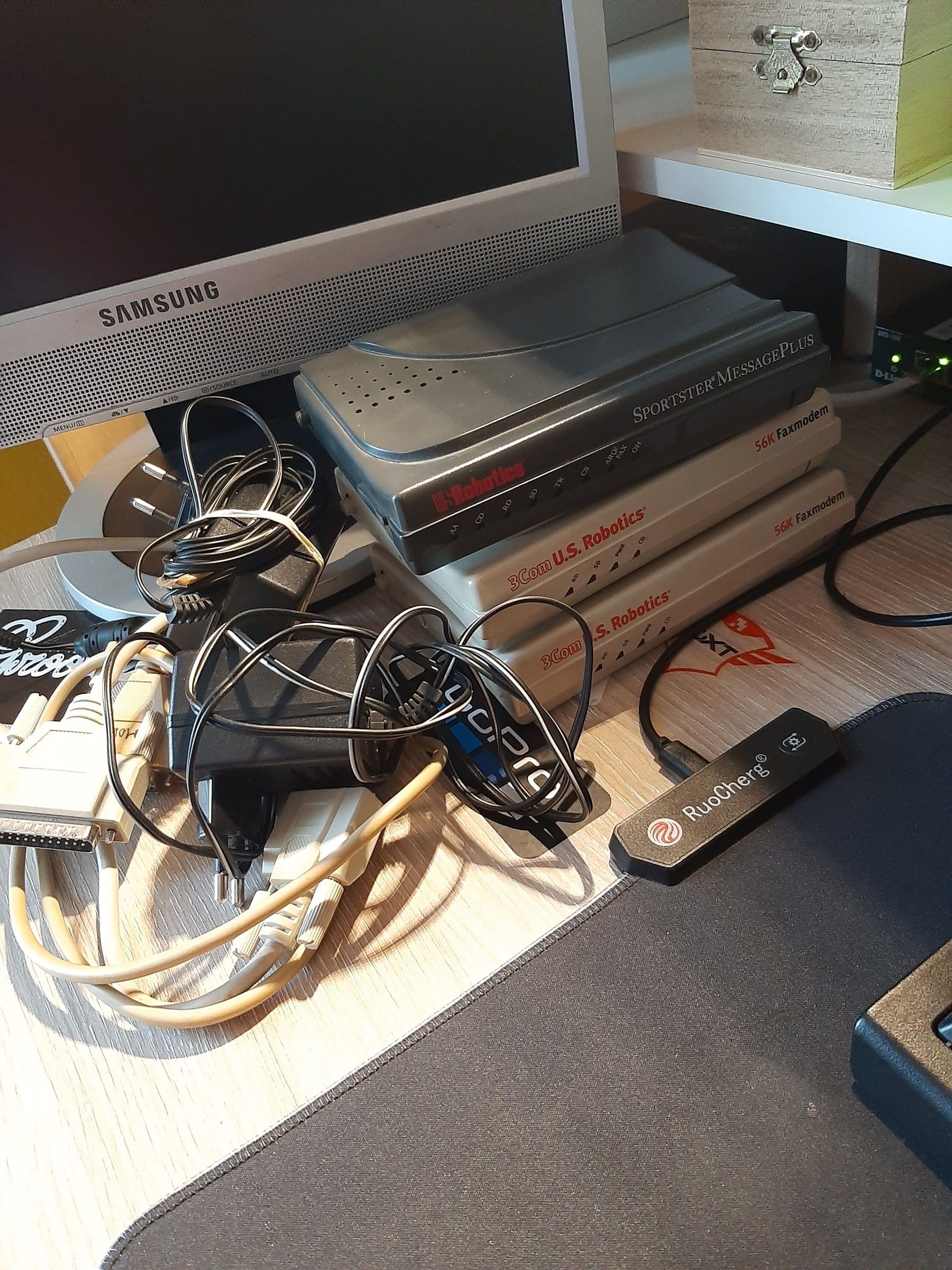
So I got some US Robotics modems, the “Sportster” and “56K Faxmodem” kind: grey boxes with little red lights, each with its own power adapter and a serial cable with the connector that has two rows of pins, the sort you hardly see any more.
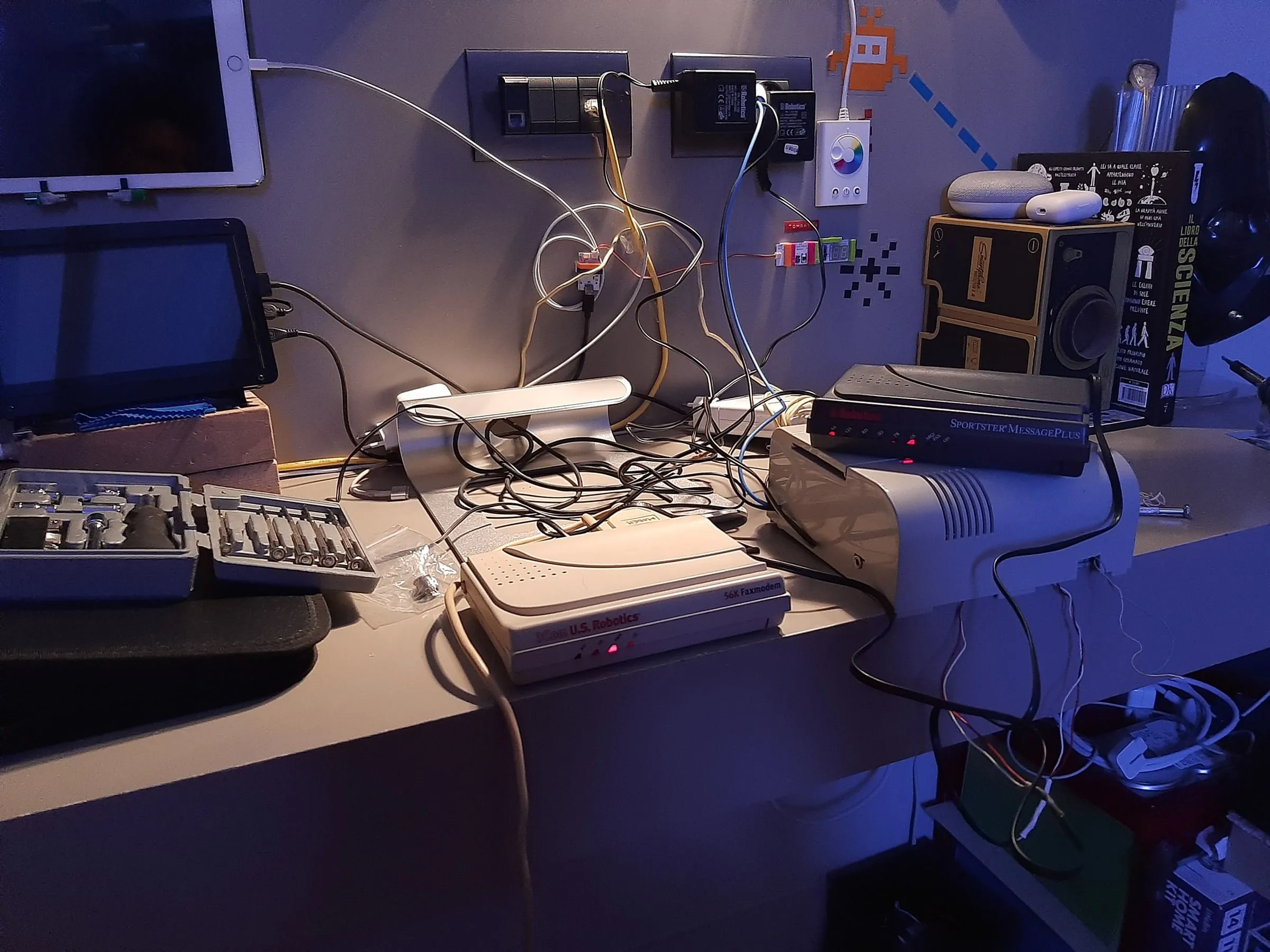 The desk, 7 May 2022.
You don’t use a modem with just any program: you type text commands to it, all starting the same way, “AT”. You open a terminal on the serial port, in my case PuTTY on COM1, and type at: if the modem is alive, it answers OK. With ati 3 it tells you who it is.
There was a problem: at home I had no PC old enough to still have a serial port on the back. The first time I talked to one of my modems I did it at school: I went to the lab, during another class, and connected to the serial port of one of the computers there. When it answered OK it felt like getting a greeting from another century.
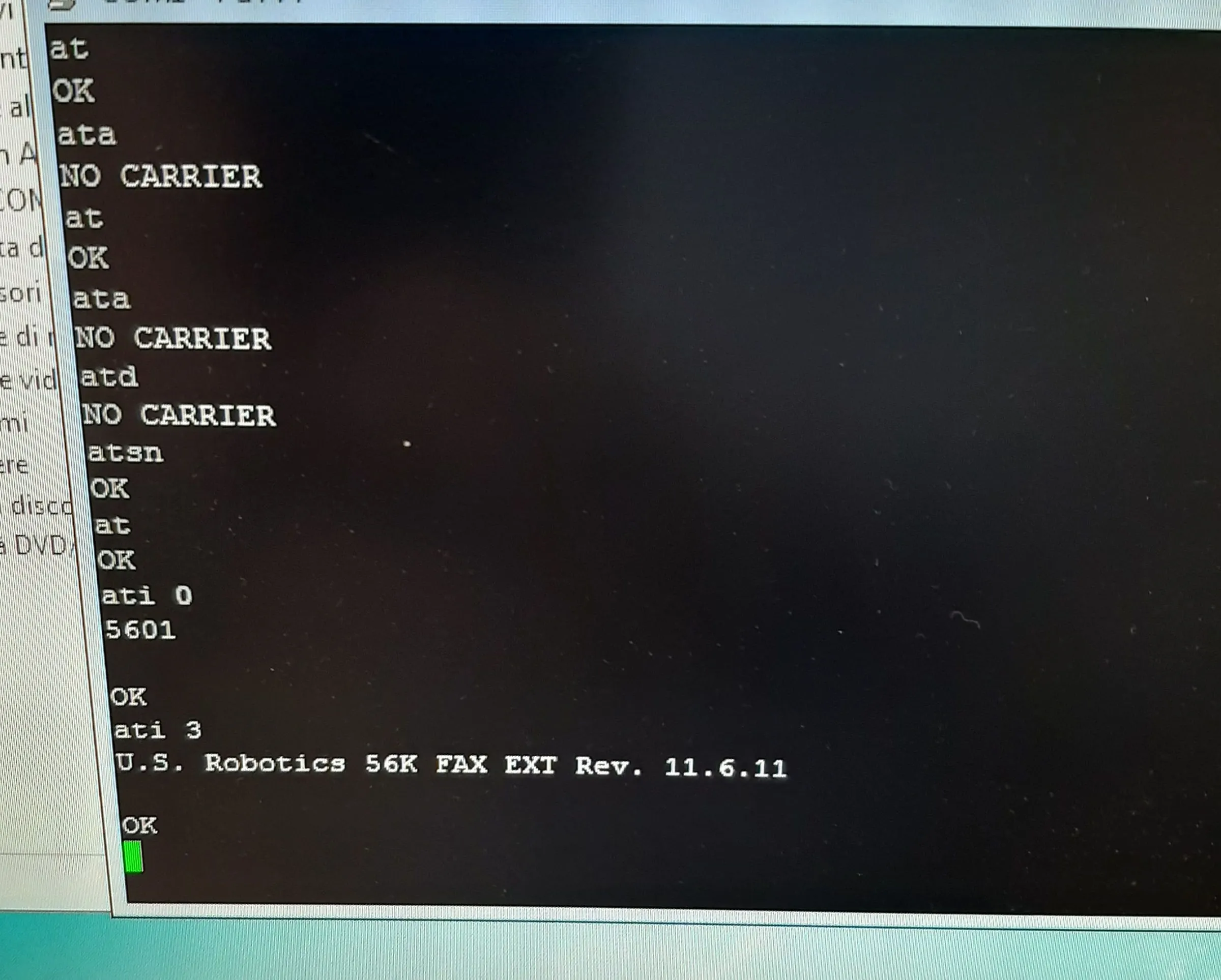 Some of the answers, 30 April 2022: after
ata and atd comes “NO CARRIER”, meaning there was nobody at the other end.
I noted down the commands I needed: ATDT number dials with tones, ATA answers an incoming call, ATS0=3 makes the modem answer by itself after a few rings, ATX0 turns off the check for a dial tone.
A telephone network of my own
To connect the modems I also bought a telephone exchange, fully analogue, and with it I built a small private telephone network, mine and nobody else’s: telephones and modems joined by wires I had run myself. It works the way everyone’s used to work, except that I built it, wire by wire. I had bought the exchange second-hand and there was no documentation at all: I sat down with a few telephones and tried every number, one after the other, to find out what answered where. I never really understood how it was configured.
At home I still have a big box labelled “Telefonia” (“Telephony”): inside are exchanges, dial-up modems, telephones, adapters and telephone cables, everything I have collected since.
Two home modems
Among the modems I met along the way were also those the operators gave to their customers. For the Alice Gate I gathered the guides and the firmwareThe program that runs inside an electronic device and tells it what to do. that circulate on the forums, but I never touched it. The TIM Technicolor, instead, I did: I unlocked it. I rooted it, that is, got administrator access with SSH, and then installed a custom firmware on it, following a confusing guide I found on a forum. On the lid I stuck a sign: “Unlocked, rooted, VoIPMaking phone calls over the internet instead of the old telephone line: the modem acts as a switchboard for the phone at home.”.
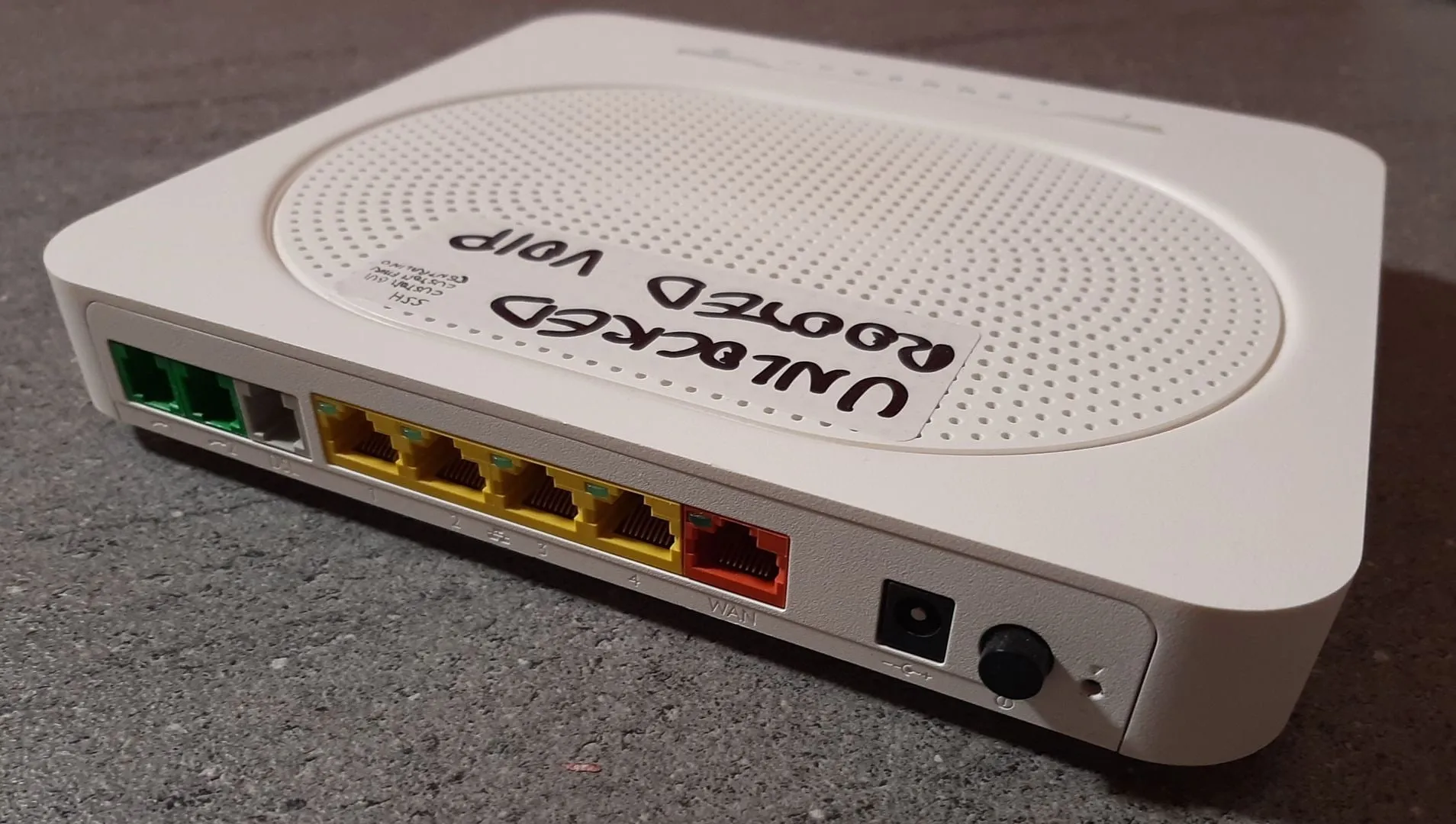 The back of the Technicolor and its sign.
I had written down all the steps in a detailed article on my old wiki: unfortunately that wiki was lost, and the guide with it.
The wire to my grandmother
The part I care about most is the last one. I tried putting the service on my home server: whoever connected by dial-up got the internet. I was thinking of my grandmother’s house, which only has a telephone subscription and no internet: from there, with a modem, you could connect to my server and, through it, reach the internet. And I really did it: from my grandmother’s house I connected by dial-up to my server.
That system is gone today. But it was lovely, and it taught me a lot.
What I learned
That old things are understood better with your hands than from books, and that behind every technology that looks dead there is a line, a wire, a person at the other end. I never heard the whistle of that connection. I built a place where it could still happen.