2024
LoRa weather stations at school
Three solar-powered stations that measure the weather and send everything by radio to a server. My first project with LoRa networks.
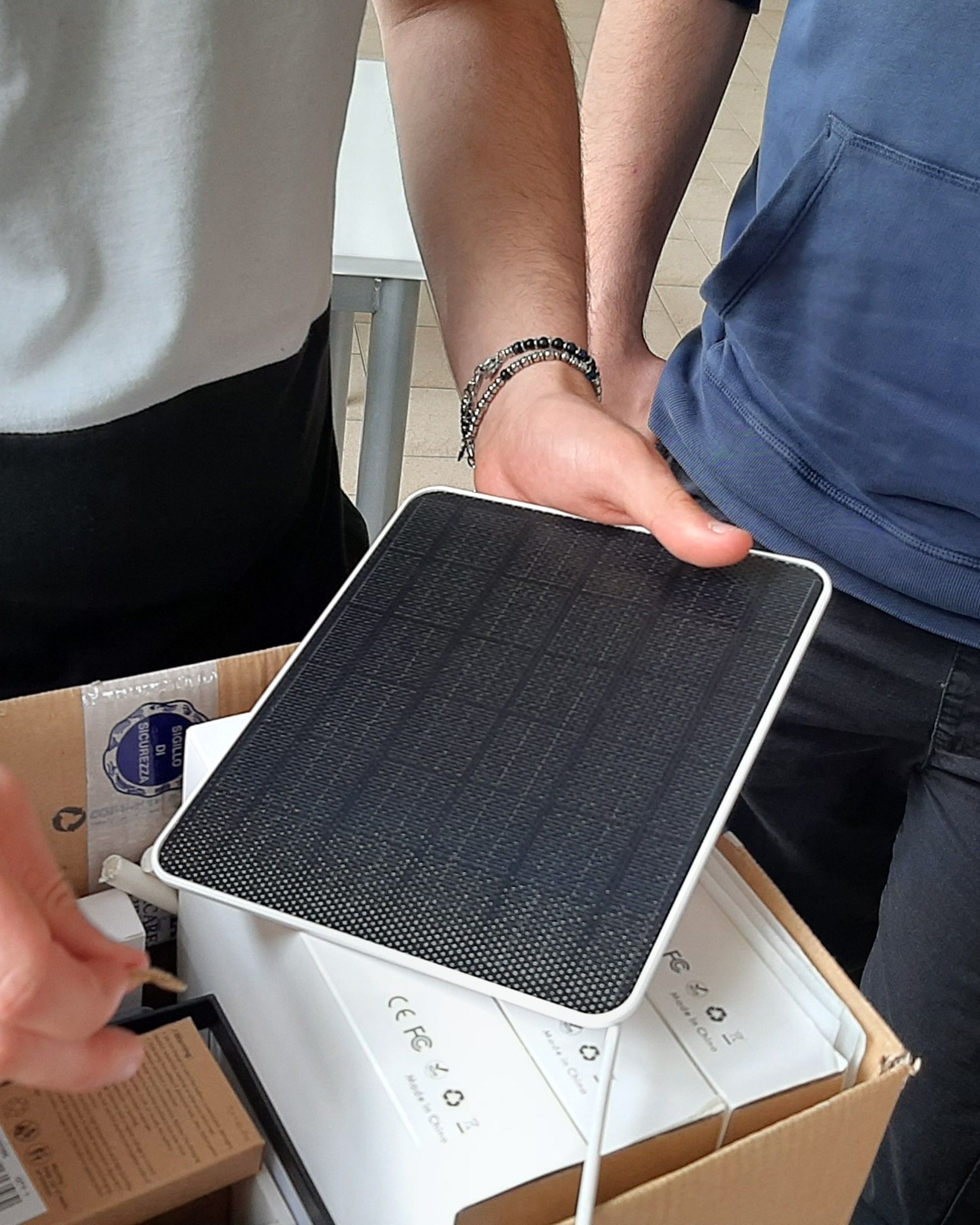
This was a school project, at my technical high school (the ITIS Galileo Galilei in Crema, Italy), in the spring of 2024. The school funded it: we had to build something with a clear purpose and then present it. The idea was simple to say: three stations spread around the area that measure the weather and the air quality, and send the data by radio, with no internet and no cables, to a server where anyone can look at it.
For me it was the first time for a lot of things at once: LoRaA way of sending small amounts of data by radio, but very far and using very little battery. and MeshtasticA free, open project that turns small LoRa radios into a mesh network for sending messages and positions without the internet. put together (I had only just come across Meshtastic), my first server receiving real data, my first database, my first graphs, my first sums with solar panels and batteries. Looking back, it’s the ancestor of EnjoyBuds.
Inside the box
Each station is an electrician’s junction box, sealed against rain and dust. Inside there’s a TTGO LoRa32 board, which does the radio, and a BME680 sensor, the small purple board, which measures temperature, humidity, pressure and air quality. Outside there’s an antenna and a solar panel; inside, a 3700 mAh battery keeps everything running at night and on cloudy days.
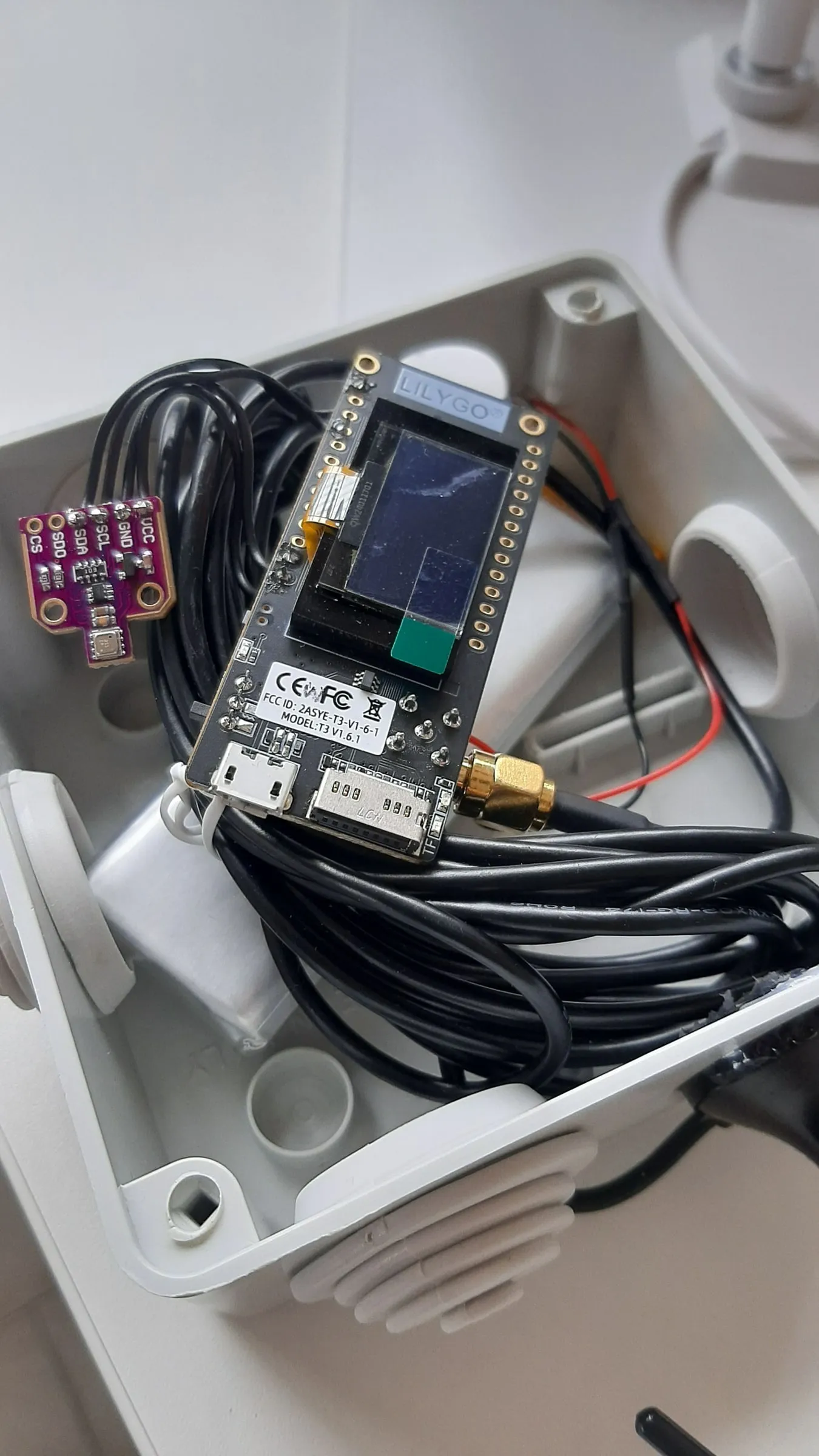 An open station, 30 May 2024.
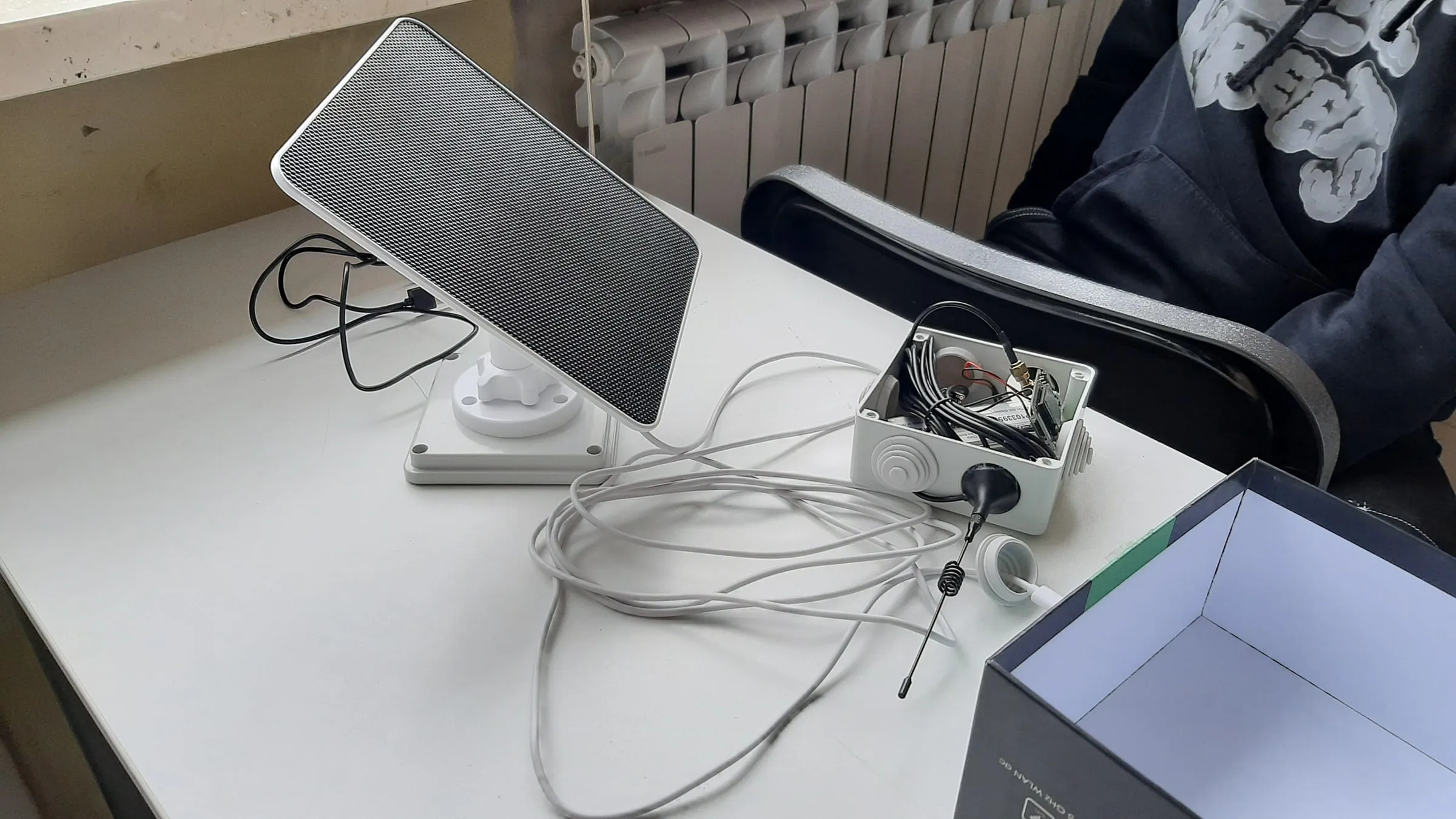 Testing on the bench, with the panel fitted.
The boards transmit at about 100 milliwatts, within the European rules for licence-free bands: not much power, but with LoRa it’s enough to reach far. We built three identical ones and placed them in different spots around Crema.
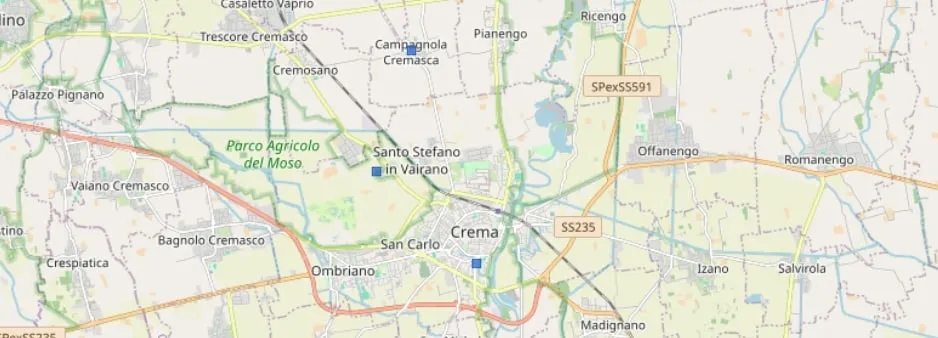 Where the stations were.
From radio to graph
The three boards talk to each other with Meshtastic, a free project that builds a network where every node passes messages on to the others, encrypted, even where there’s no internet. One of the three is also the gatewayThe bridge between the radio network and the internet: it receives messages by radio and sends them to a server, and back.: it connects to WiFi and sends everything it hears to an MQTTA lightweight way for programs to talk to each other: senders publish on a topic, and whoever is interested receives it. server, which at first ran on a Raspberry PiA computer the size of a credit card, cheap and easy to program. 3 and was moved to a virtual machine at the end of the project.
From there, a first program decodes the messages, which travel in a compact format, and republishes them in plain form; a second one saves them in a MySQL database; GrafanaA program that reads data from a database and draws it as graphs and dashboards. reads them and draws them on a public page of graphs. That page is gone now: the virtual machine lived on the school’s server, and they switched it off when the project ended.
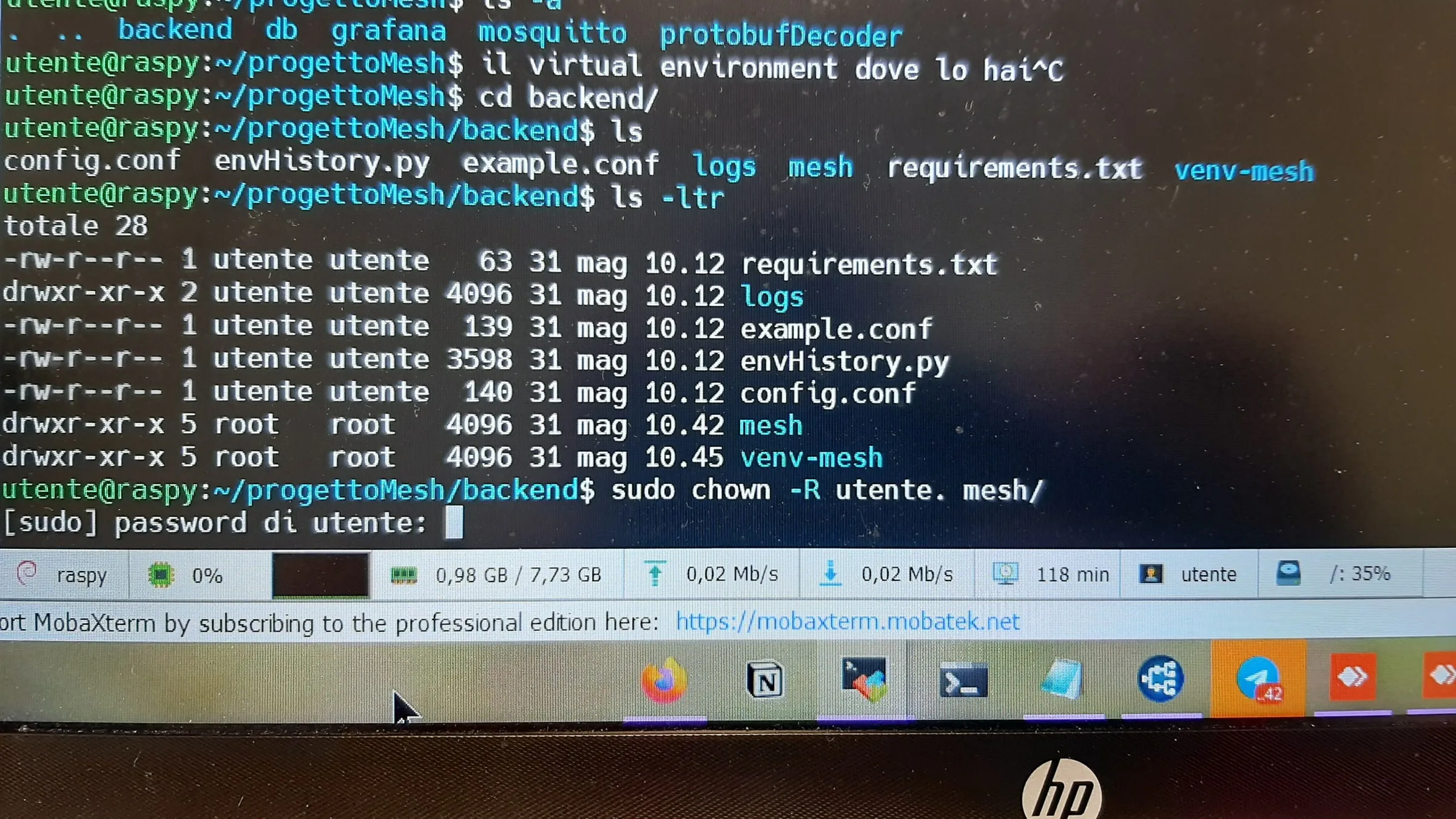 Working on the Raspberry Pi, 31 May 2024.
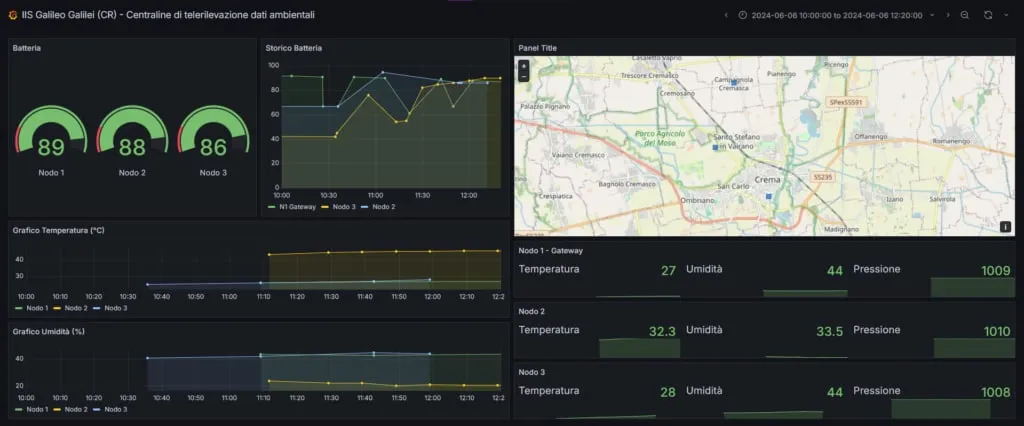 The dashboard with the stations’ data.
What I learned
That between a sensor and a graph there are lots of pieces, and any of them can break: the radio, the gateway, the server, the decoding program, the database. That a battery and a panel have to be sized for the bad days, not the good ones. And that when something like this works, and you see data arriving from a place where nobody is, you want to build a bigger one.
That’s what happened next, on Monte Ucia and with EnjoyBuds.