since 2024
Monte Ucia
On the mast of the radio station at the top of the mountain, Ernesto, Alberto and I put up two solar-powered repeaters for mesh radio networks. They cover a good part of the Po Valley.
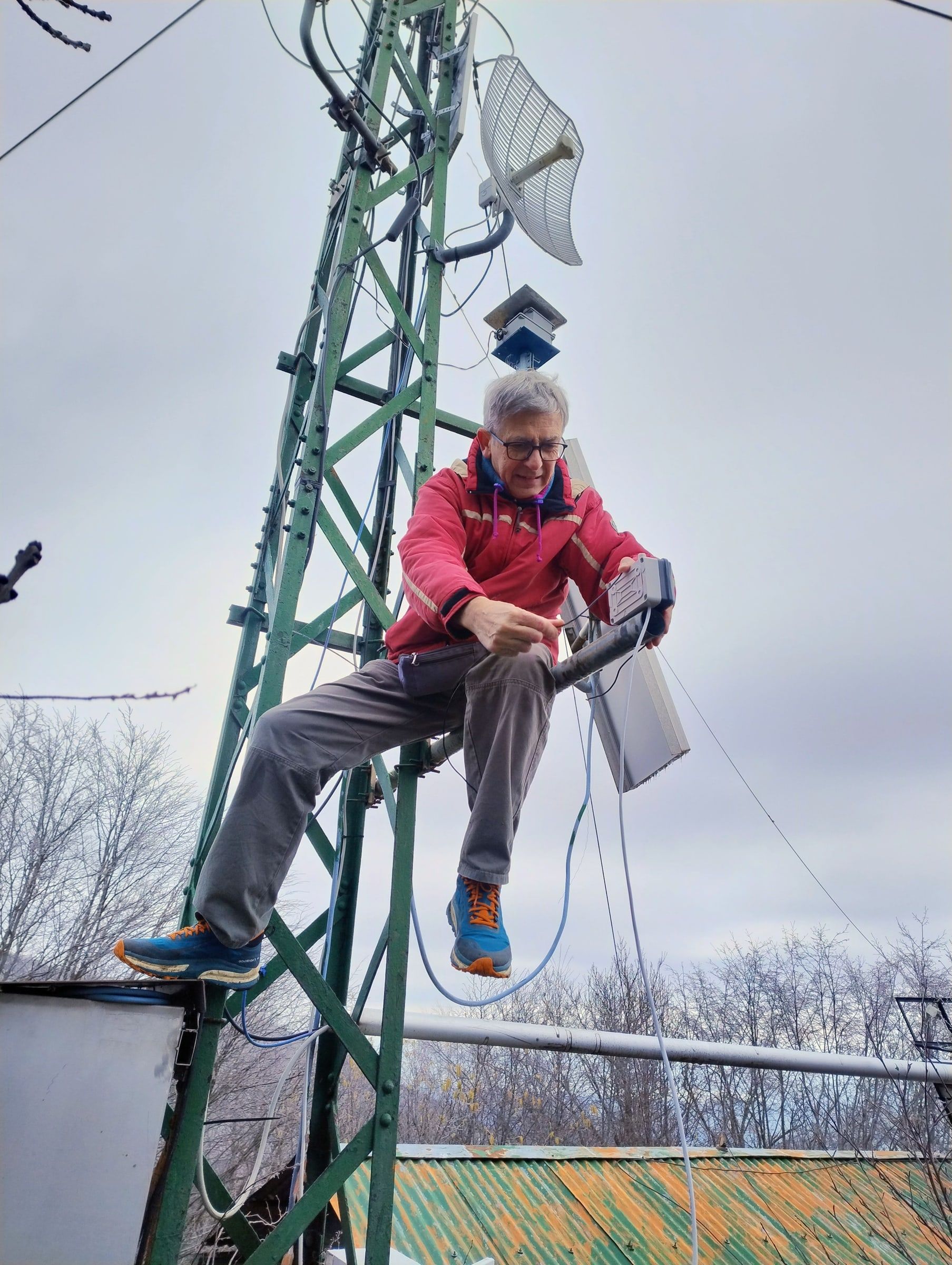
Above Serle, more than a thousand metres up, there’s a small green hut with a mast next to it. No road goes there and no power line either: you walk up, about forty minutes from the car park, with a backpack full of tools. From the top you can see Lake Garda on one side and the whole plain on the other.
It’s the Monte Ucia radio station, owned by the Brescia branch of ARI, the Italian amateur radio association. It’s also where, on 18 March 2025, the first LoRaA way of sending small amounts of data by radio, but very far and using very little battery. repeaterA radio placed up high that receives signals and sends them out again, so they travel further. in the province of Brescia went on air. Before telling my part, though, it’s worth telling the story of the place, because it’s a lovely story about people.
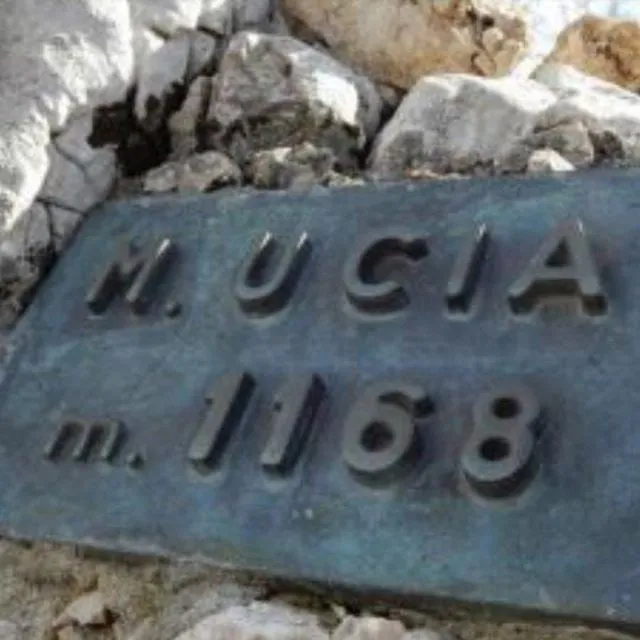
A site bought by a radio club
In December 2011 a member of the branch told the board about a mountain site that was for sale: a fenced plot in the woods with a six-metre mast, a frame for solar panels and a hut. No power, no road. On 27 April 2012 the members voted to buy it; by June 2012 the site belonged to the branch.
From then on, everything went up on someone’s back. In 2013 the first batteries and the first two solar panels; in 2014 a system to control everything remotely by radio, with telemetry reporting the state of the batteries every five minutes. That same year the 2.3 and 5.7 GHz beaconsA small transmitter that always sends the same signal: whoever picks it up, even far away, learns how radio waves are travelling., small transmitters that send the same signal over and over so anyone can measure how radio waves travel, were heard as far away as Switzerland.
Then, as happens, the enthusiasm faded. From 2020 a small group of members took it all back in hand, almost always paying out of their own pockets: Fabio I2LQF; Giuseppe I2NOS, who has written up the site’s adventures every month for years in La Radiospecola; Ernesto IZ2FLY; Adelio IZ2DJP; Toni I2IPK, who designed and etched the circuit boards at home; and Evaristo IK2YXQ, for years the site’s point of contact. Evaristo passed away in June 2026: I remember him here with affection.
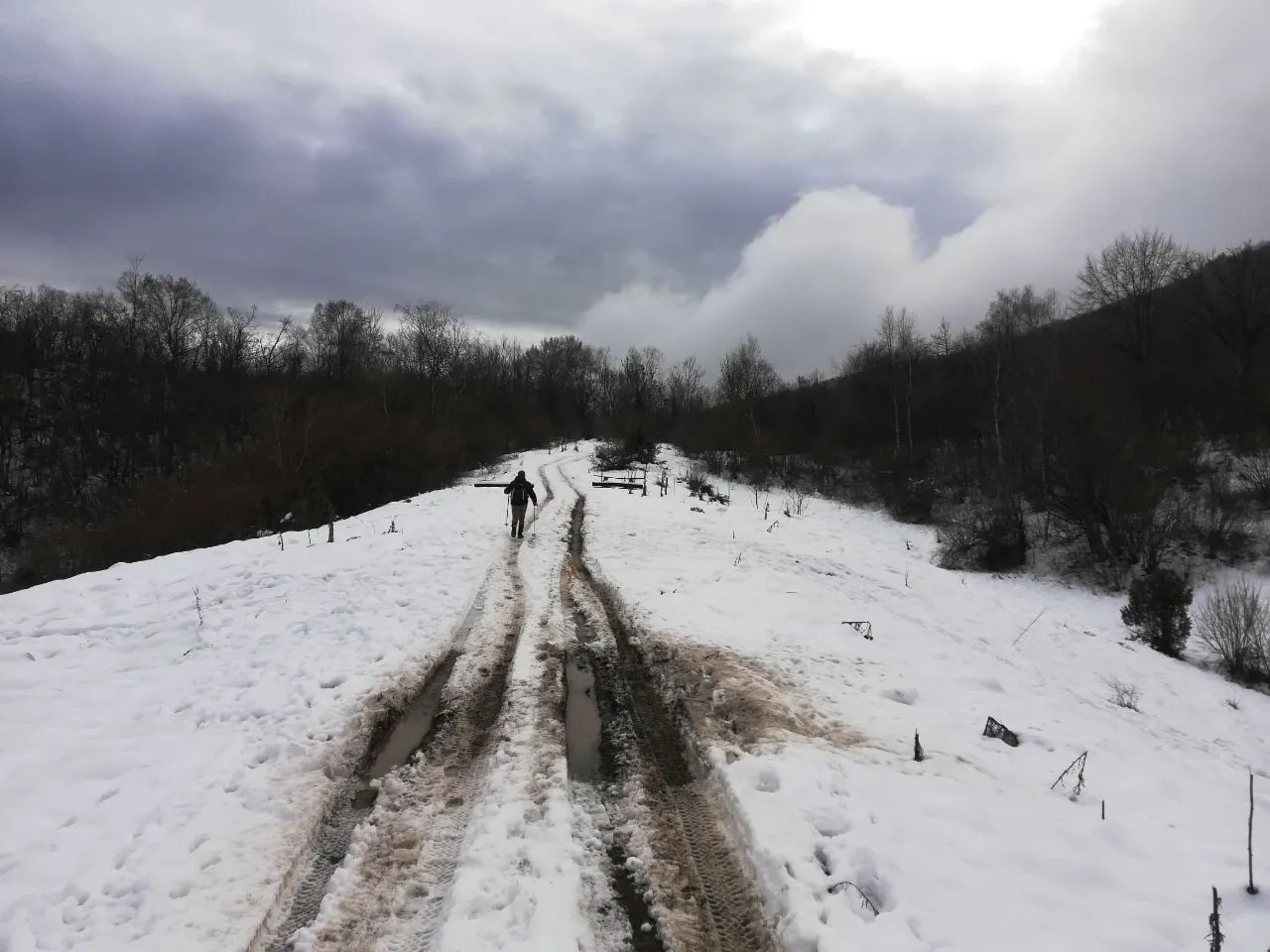 A climb in December 2020, in the snow. Photo from the group’s archive.
In those years all sorts of things arrived on the mountain. A 5 GHz radio link down to the plain that brings the internet up there: Ernesto and Adelio installed it in December 2020, in more than half a metre of snow. A receiver that anyone in the branch can listen to from their computer, and that hears the whole world with just a wire for an antenna. 10 and 24 GHz beacons picked up from Milan to Bologna. And a 432 MHz beacon that Ernesto built out of a recovered radiosondeA small box with GPS and sensors hung under a weather balloon: it measures the air as it climbs to thirty kilometres and sends it all to the ground.: with 50 milliwatts, less than a tiny light bulb, it was heard in Corfu, 1015 kilometres away, on 16 August 2024.
The mountain gives nothing for free, though. The wind melted a connector and shorted half the system; a mouse chewed through a cable; a whole ant colony moved into the receiver box; at zero degrees the charge controllers stop charging the batteries. In 2023 new lithium batteries arrived, four cells weighing more than five kilos each, carried up a few at a time.
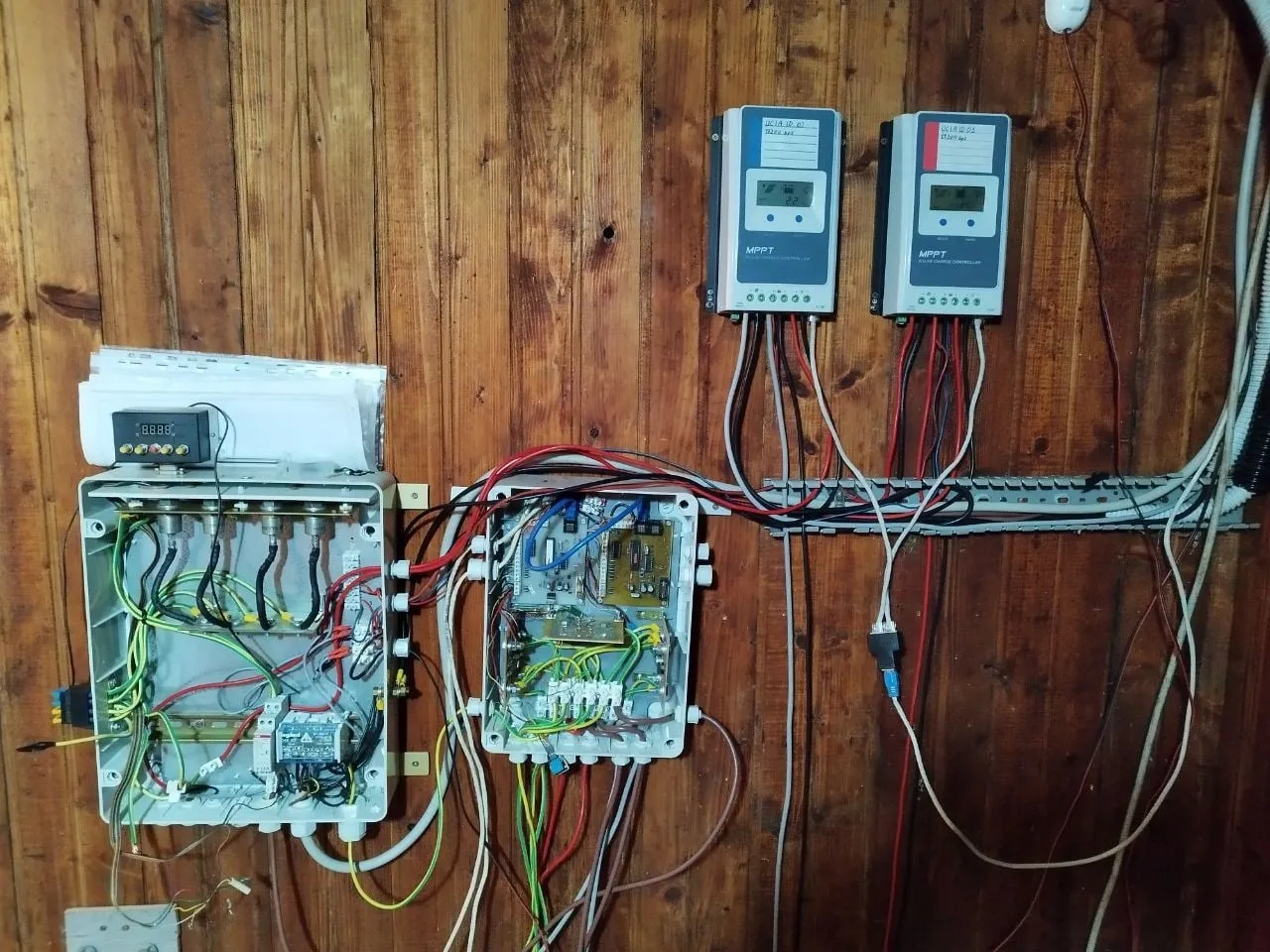 The new electrical system, October 2023. Photo from the group’s archive.
How I got there
When I moved to Brescia to study, I found out that the ARI branch was close to the university and that some people I knew were already members. They invited me to an evening presentation about Monte Ucia on 4 October 2024: I left after midnight, with a slice of cake and a strong wish to go up there.
I climbed it for the first time on 9 November 2024, with Ernesto and Alberto IZ2FNH. In three hours we installed the new remote control system in a watertight box and redid the wiring. By the end the site was much tidier, and Giuseppe wrote in the group chat: “Reinforcements have arrived”.
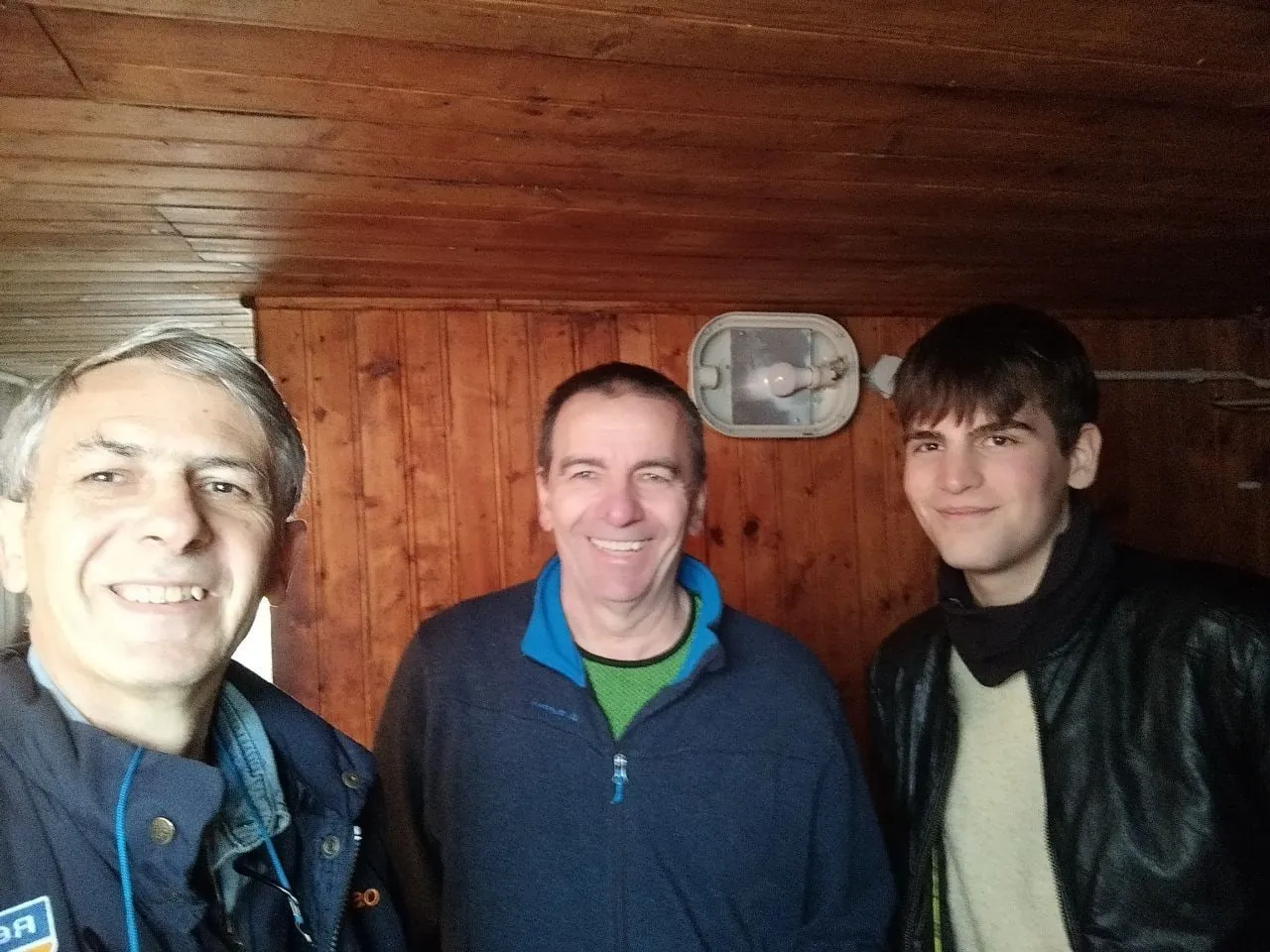 Ernesto, Alberto and me inside the hut, on my first climb.
In December I passed my amateur radio exam. In January 2025 I was back up with Ernesto, this time with my own call signThe code the state gives every radio amateur, said at the start of every contact. Mine is IU2UEI., IU2UEI: we put his beacon back up and found the 10 GHz receiver full of water and crumbling.
The first LoRa repeater in the province
LoRa is a way of sending small amounts of data by radio, very far, using very little power. With MeshtasticA free, open project that turns small LoRa radios into a mesh network for sending messages and positions without the internet., a free project, small devices pass messages to one another and form a network that works even where there’s no internet or phone signal. The higher a node is, the further it reaches: Monte Ucia was the perfect place.
On 18 March 2025 Ernesto and I went up on a cold, cloudy day. Ernesto had forgotten the keys to the hut, so the site’s batteries were out of reach: we powered the node from his beacon’s battery through a small converter. The node was called “ARI Brescia Ucia”. On paper it would cover the plain from Milan almost to Padua; the first contact came from Ivrea, 194 kilometres away, then from 247.
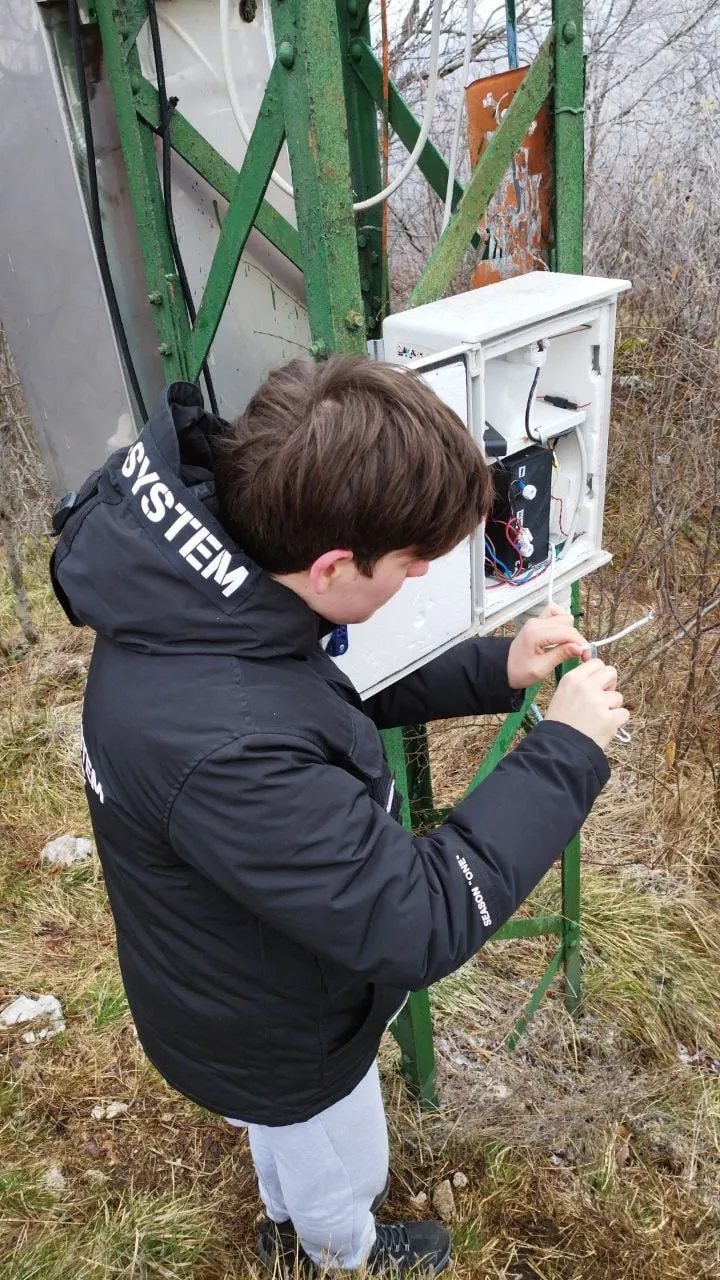 18 March 2025, at the node we had just installed.
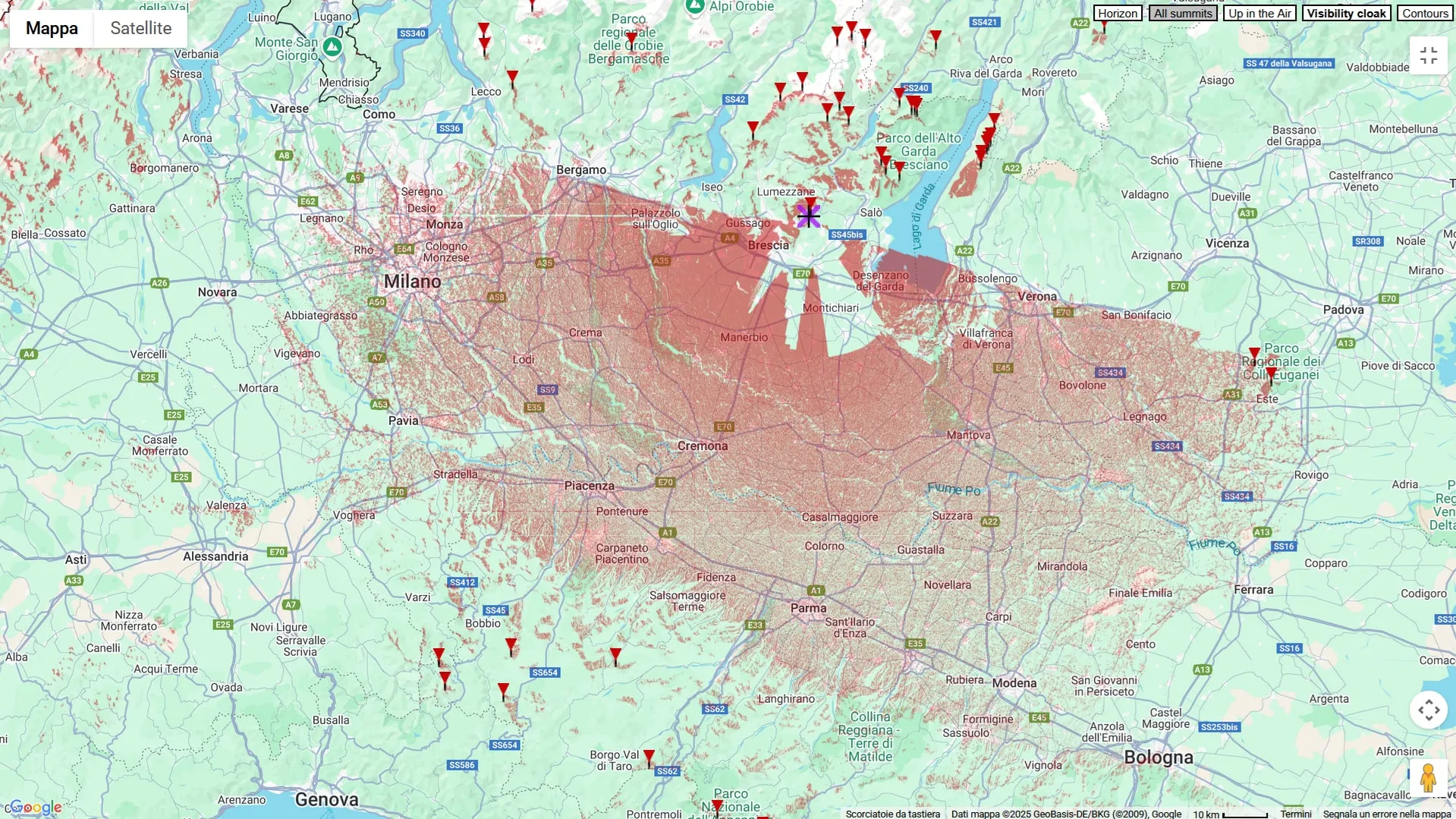 The coverage simulation for the node.
A week later we went back up to update it and fix it more firmly. In April I published a YouTube video explaining how to send messages without the internet: within a few days it passed eighty thousand views (today it has more than a hundred and fifty thousand), and the LoRa Brescia group grew to almost five hundred people: today we are nine hundred.
Nodes that live on their own
The first node depended on Ernesto’s battery. I wanted nodes that could stand on their own, with their own panel and battery, and that could cope with water: when we opened the old box, there was water inside. So I designed a new modular box, with a membrane vent valve that lets moisture out without letting rain in. I did end up installing it on Monte Ucia, without the secondary module, and over time it was replaced by a more compact node.
On 22 February 2026 I went up with Alberto and Gianfranco, a friend of his: it was the first time without Ernesto. We cut back the vegetation, fixed the roof and installed two nodes: a Meshtastic node with its own small panel, battery and a temperature and humidity sensor, and next to it a MeshCoreAnother free program for LoRa mesh networks: only fixed repeaters pass messages on, which keeps the network lighter. node, the other meshA network with no centre: every device receives messages and passes them on, so they reach places a single device couldn’t. network, as an endurance test.
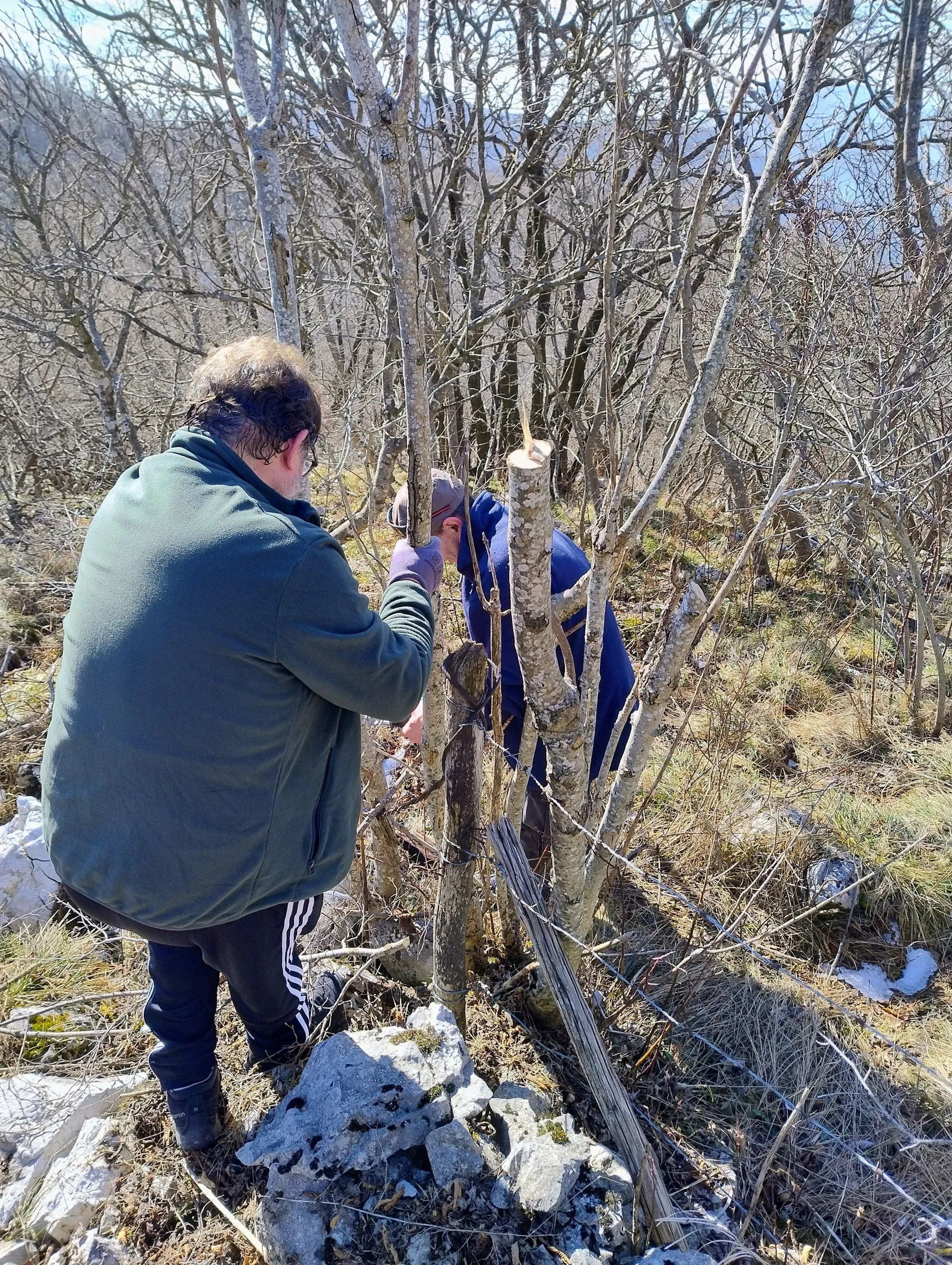 Cutting back the vegetation, 22 February 2026: Alberto on the right and a friend of his on the left.
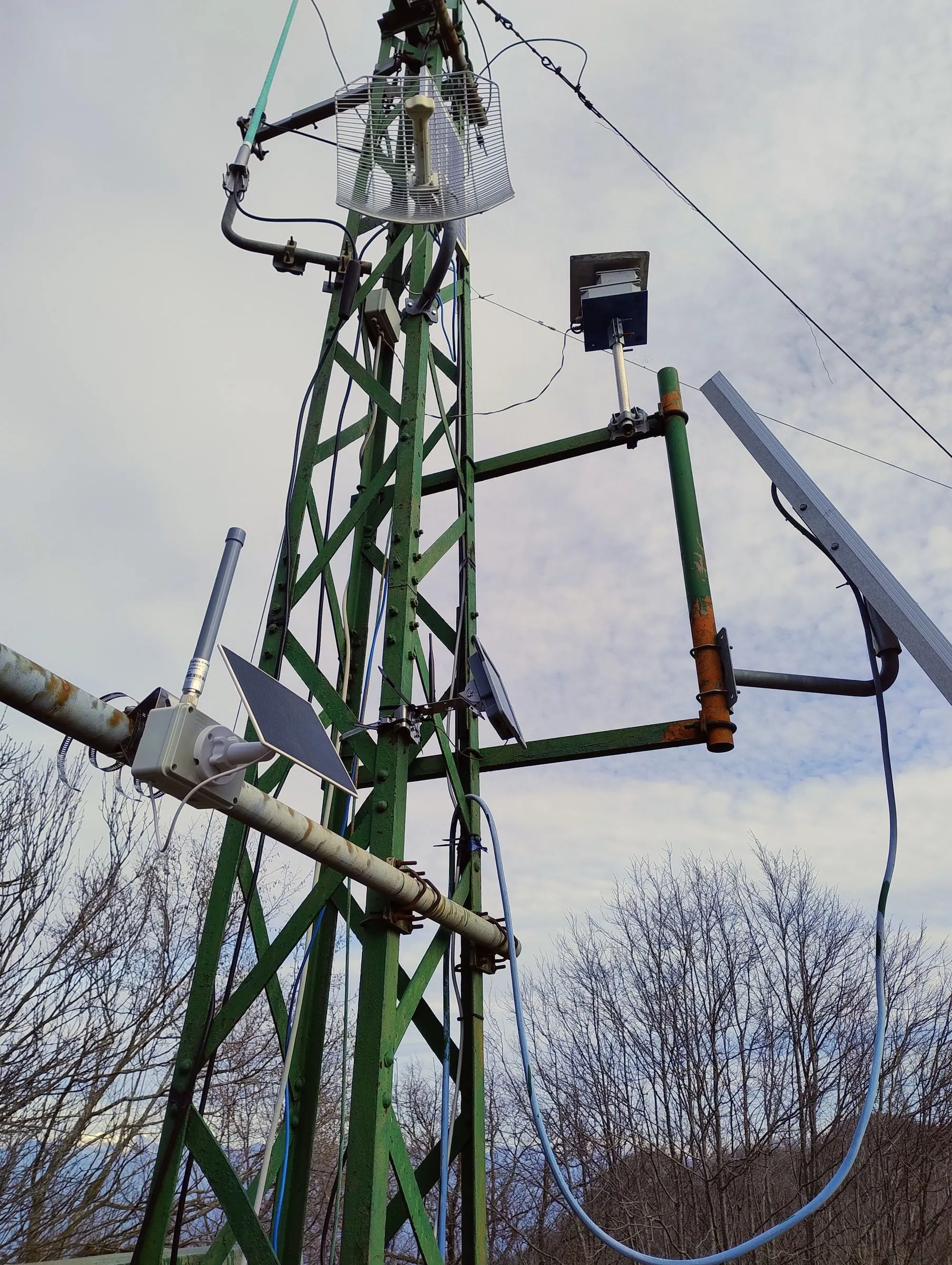 The two nodes on the mast, each with its own panel.
Four days later I went back with my friend Fabio: we moved the MeshCore node away from the mast and thinned out the trees around it. Since then MeshCore sometimes receives even better than Meshtastic. Fabio also flew his drone over the site, and that video is now on the branch’s project page. Meanwhile, a directional antenna I had 3D printed had gone limp: the material wasn’t made to live outdoors. Ernesto built one himself.
In June 2026 Alberto, Fabio and I went up again for a big clean-up: chainsaw, piles of firewood, new fence posts and the roof nuts sealed against leaks.
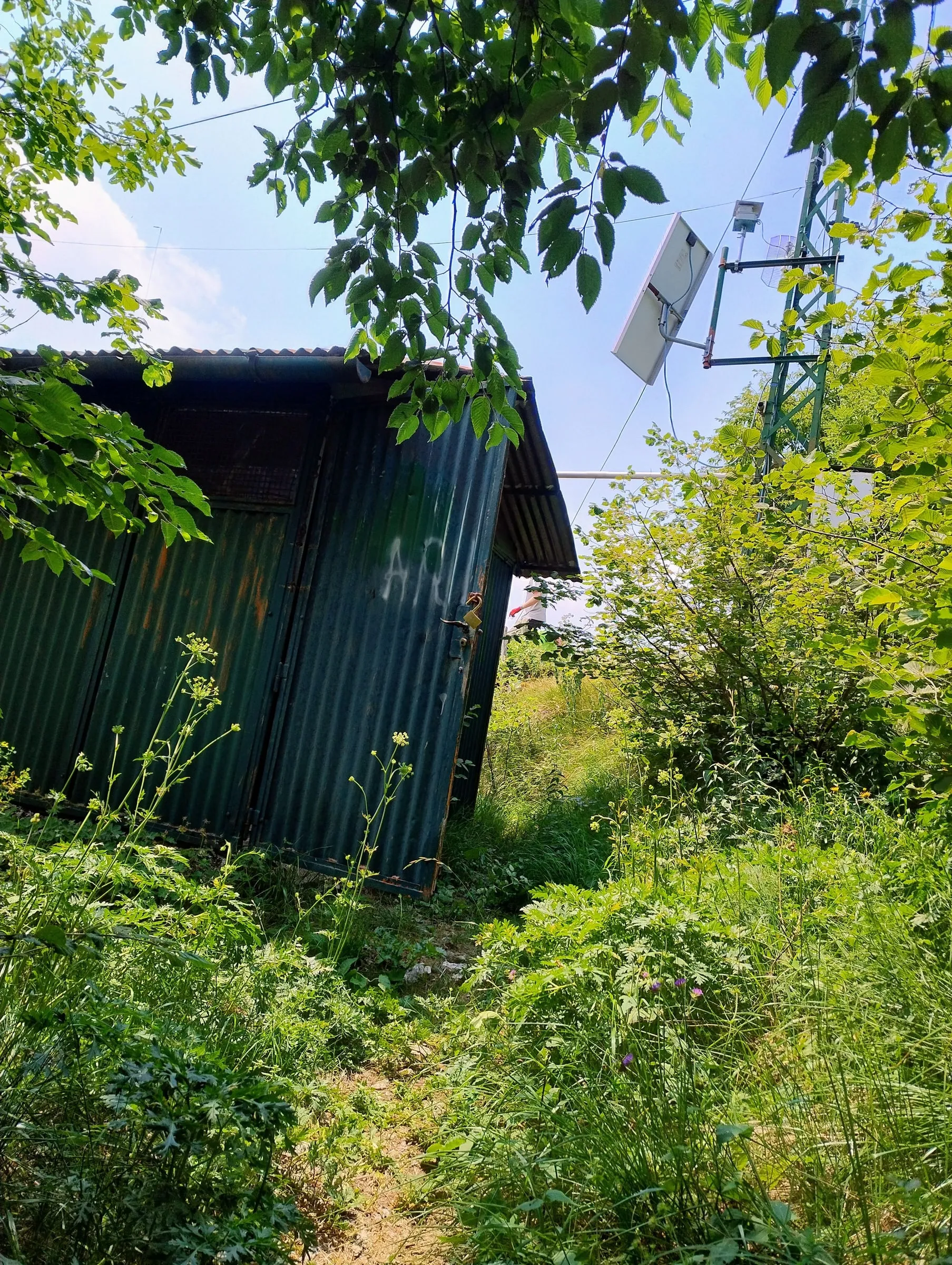 The hut at the end of June 2026: in summer the woods take everything back.
What I learned
That outdoors, in the mountains, everything breaks in ways you’d never have imagined: wind, water, mice, ants, cold. That the wrong material, outdoors, shows itself straight away. That energy is counted in winter, not in summer.
Above all, I learned from people who have been climbing up there for years, at any age and in any weather, just because they believe in it. I brought a new network; they taught me how to keep a site running. The nodes on Monte Ucia now serve many people who have never been up there, and that’s what I’m proudest of.